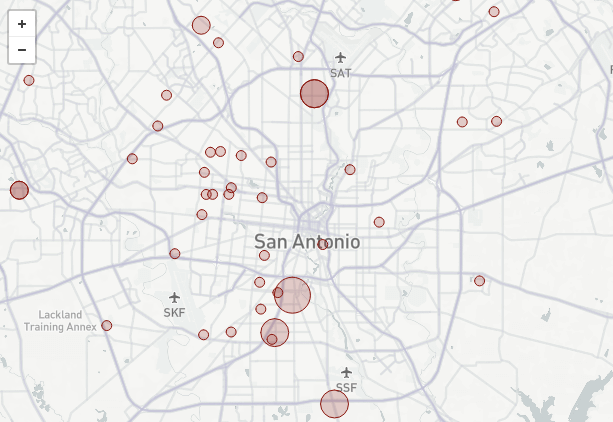
But where are all these newcomers moving to within Bexar County?
Kelly Guckian, database manager for the San Antonio Express-News, pulled together more detailed population figures from the 2010 Census to help show where Bexar County is gaining residents — and where it’s losing them.
Kelly focused on census tracts, which are geographic boundaries set by the Census Bureau that encompass, on average, about 4,000 people. This allowed her to zoom in on population changes at the neighborhood level. She did the tedious work of compiling and mapping the data, and I helped export it into this interactive Google map that shows how the far West and North sides of the county saw explosive gains in the blue areas, while many inner city neighborhoods in the yellow areas lost residents. Kelly and graphic artist Mark Blackwell also produced maps showing the population trends broken down by race and ethnicity, and MySA’s Mike Howell put it all together in an interesting package online.
The explosive growth on the county’s outskirts occurred during a decade when city officials emphasized the importance of living near downtown and limiting urban sprawl. Our news story about the Census numbers explored why many people either didn’t hear the city’s message — or ignored it.
In the news business, sometimes the worst part about major events is writing about their anniversaries. They arrive year after year with all the predictability and excitement of receiving Christmas fruitcake from your Aunt Helga. There’s usually no new information to offer, and the hapless journalist gets stuck trying to come up with an interesting story.
So I was pleasantly surprised by the Alamo Immortal project published by the San Antonio Express-News, which put a creative twist on the old story of the Battle of the Alamo and its 175h anniversary.
The idea was the brainchild of Dean Lockwood, director of news production at the newspaper. A history buff who knew the big anniversary for the Alamo was coming up, Dean started brainstorming a few months ago about new, original ways to cover the event.
“Sad to say, it’s something that can get a little taken for granted in the media,” Dean told me. “It’s something we cover year after year. You know, the same picture — Dawn at the Alamo.
“We could have gone that route and done the obligatory feature and a couple of other little things and everybody would have been fine with that,” he said. But Dean wanted to try something new, and he brainstormed with art director Adrian Alvarez. (more…)
Express-News religion writer Abe Levy wrote the most comprehensive story to date about the troubling saga of Father John Fiala, a Catholic priest who was accused of raping a 16-year-old boy in Rocksprings — and then soliciting a hit man to kill the teenager.
Abe relied on hundreds of court records to trace Fiala’s past transgressions, and the Catholic Church’s inability to deal with the priest:
The trail of complaints against Fiala began in the 1980s. In Nebraska, a businessman claimed Fiala targeted his eighth-grade son in 1988. The father, who the Express-News is not naming to protect his son’s identity, says Catholic supervisors broke promises then to ban the priest from all ministry with children and adolescents.
“I have no idea — I shudder to think — how many other children (Fiala) has harmed since 1988,” the man stated in a 2010 affidavit letter to Texas authorities after the Rocksprings teen filed suit. “My church could have prevented any further harm if they would have acted responsibly, but they chose not to.”
Abe told me he primarily relied on documents obtained through pre-trial discovery motions stemming from a lawsuit against Fiala and other defendants. The reporting process, he said, demanded “lots of careful reading, taking notes, and making a chronology.”
Many of the allegations against the priest are old. But as Abe’s story notes, the most recent allegation was made in 2008 — years after an overhaul by the Catholic Church in 2002 that was supposed to improve accountability and prevent abuse against children.
“They still did not catch this guy,” Abe said.
Some readers are sure to react to the story as an attack against the Church. Abe said there’s certainly abuse that occurs in other religions. But Catholicism is the largest faith group in the United States, with 68 million followers. It’s also the largest religion in heavily Hispanic San Antonio, with more than 700,000 parishioners.
“I don’t think it’s an attack,” Abe said, noting how the reaction from Church officials about the allegations against Fiala has been subdued. “No one disputed the fall from grace that this guy experienced.
“I think there are really good people in the Catholic Church,” Abe added. “There’s stuff that they do that’s fantastic.”
A prime example: A day after Abe’s story about Fiala was published, Abe wrote yet another story about a Catholic priest. But this tale was about a courageous priest named Father Ted Pfeifer, who risked his life in Mexico to protect villagers from drug cartels.
The timing of the two stories was coincidental. But it illustrates what Abe says is one of the most important things in journalism:
“Be true to the story,” Abe said. “I need to follow it wherever it leads, not where I think it should lead.”
A collection of public records, videos, news coverage and other resources about the garage at University Hospital that collapsed on Feb. 14. Two workers were injured in the accident — one critically.
A great news story tells readers something new about the world in a compelling way. It’s even better if the reporter digs up the story through her own initiative. And it’s even better if the issue is so important or shocking that readers simply can’t put down the paper or — nowadays — their iPad.
Michelle Mondo’s bizarre story about four women who might have been wrongly convicted of molesting two girls certainly qualifies.
Michelle learned of the case when an essay about it was published in April 2009 in Texas Monthly. The author, a Canadian professor named Darrell Otto, had been surfing the Internet and found a 1998 Express-News article about four friends — Anna Vasquez, Cassandra Rivera, Elizabeth Ramirez, and Kristie Mayhugh — who were all serving long prison sentences for a strange crime:
Four young women in that city, acting on their own, had allegedly restrained and, in ritualistic fashion, sexually assaulted two girls, aged seven and nine, over two days. There was no physical evidence tying the women to the assaults, yet the newspaper reported the case against them without a hint of skepticism. It mentioned nothing about mental illness or confessions. Psychology-wise, the only point noted was that the women were lesbians, although academic research clearly shows lesbians are not predisposed to sexually abuse children. I was frustrated by the lack of information.
Otto was convinced the women had been wrongly convicted. Express-News Metro Editor Jaime Stockwell read the essay and asked Michelle to look into the case.
This wasn’t press-release journalism that critics of the media rightly complain about. Michelle spent 18 months on the story, whittling away at it in her spare time as a crime reporter for the Express-News. It wasn’t easy. When I stopped by her desk last week to ask her about it, the beeps and sporadic radio transmissions from the police scanners she was monitoring occasionally interrupted us. Try investigating a possible wrongful conviction when at any moment you have to drop everything and run out to a structure fire.
Michelle stuck with the story. She dug up old court records, tracked down family members, interviewed the convicted women, and waded through “accusations and counter accusations involving different famlies in different states,” she said.
Her findings were published on the newspaper’s front page:
A San Antonio Express-News investigation — including interviews with witnesses and experts and a review of police reports, medical studies and thousands of pages of trial transcripts and other court documents — raises troubling questions about the scientific legitimacy of medical evidence deployed against the women, whether authorities checked a previous rape allegation made by the girls and whether anti-gay views prejudiced Ramirez’s jury.
In two trials, the defense called no witnesses to rebut the testimony of pediatrician Nancy Kellogg, then as now the medical director of Child Safe — at the time, it was called the Alamo Children’s Advocacy Center. But research available when she examined the girls classified the three signs of sexual trauma she found as either normal, inconclusive or impossible to identify as a scar, as she did.
On and off the witness stand, the girls changed their accounts of the timing, weapons, perpetrators and other basic details of the assault every time they told it to authorities, records show.
The girls’ family was mired in conflict before and after the trials, with members making abuse claims in two Texas counties and in another state. It wasn’t the first time the nieces had made a rape outcry.
The trial of Ramirez, held separately from the other women, showcased her sex life, and her jury foreman, a minister, had told attorneys that homosexuality was wrong on religious grounds.
When Michelle interviewed the convicted women for her story, they maintained their innocence — and wondered where the media had been all this time.
“All four of them asked me, ‘Why was I doing the story now?’” Michelle said.
It’s a fair question. Had reporters failed to scrutinize this case in the 1990s when it really mattered?
I checked our news archives. There were about a half dozen stories about the trials, including one with the headline: “Defendants say accusers made up story of assault.” The stories described the crime as a gang rape. I couldn’t really find any in-depth coverage — the articles ran in the Metro section and the longest one I found was about 500 words long. At the time, I had been at the paper for about a year but today I don’t even remember the trials. It looks like the charges were part of the depressing, never-ending stream of twisted child abuse and murder cases in Bexar County that we keep having to write about. Most of the time, those heinous crimes really did happen. Most of the time.
This being Texas, Michelle is doubtful the women will be freed any time soon. But after the story ran, she’s heard from the women and their families. Maybe it’s too little too late, but it means something when a third party like Michelle comes in, spends a lot of time looking at the evidence, and publicly points out inconsistencies in a criminal case that shattered the lives of the defendants.
“For them, it was a very big deal for somebody to point out, ‘Wait a minute, these women aren’t what they were portrayed as,’” Michelle said.
This story was a sobering and perplexing look at the life of a young man who suffered a traumatic brain injury in a car accident. Patrick Davis made headlines when he sued General Motors for $50 million, but after the lawsuit was settled, the media moved on and forgot about Davis.
What happened to him? After digging through a thick file at probate court and conducting several interviews, I found some answers, but they led to new questions.
You can read the news story and click on copies of the court records that I annotated thanks to DocumentCloud, a great tool for adding context to primary documents.
You can also check out this interactive timeline on Dipity to trace the history of Patrick Davis, who still has his dry sense of humor after all these years.
Until recently, I had no idea this DPS database existed. But I stumbled across it a few months earlier when I was working on this article about pursuits in San Antonio. SAPD keeps a database packed with details about each chase — the weather and road conditions, the pursuit speeds and durations, the injuries and fatalities. Since SAPD had this data, I figured other law enforcement agencies in Texas probably kept similar records. I asked around and sure enough, DPS was one of the agencies that collects details about pursuits.
Why is that a big deal? Well, when you find a previously unknown database with information about an important public safety issue and analyze those digital records, you’ll probably discover fresh, interesting information for your readers. Public databases empower journalists to do their own research and find surprising answers.
Brandi asked for a copy of the data and we received it from DPS with little trouble. It was a big spreadsheet documenting nearly 5,000 pursuits from 2005 to July 2010.
One detail jumped out at us: Hidalgo County, by far, had the most pursuits over the past five years — 656. Several other border counties also ranked high, suggesting smugglers were often fleeing DPS troopers. The database told us all kinds of things about these pursuits — how often people were injured, how often motorists escaped, and how they got away.
When reporters dive into data-heavy topics, it’s important to find the real people behind the numbers. We asked DPS early in the reporting process to go on a ride-along with a trooper in Hidalgo County. Brandi and photographer Callie Richmond visited McAllen and went on a ride along with DPS Trooper Johnny Hernandez. Their experience became the lede of our story. Brandi had some great interviews with Hernandez and other troopers in Hidalgo County, who openly talked about their continual struggles to catch smugglers from Mexico. The visit provided rich material for photos and an awesome online video that Callie produced.
Brandi wrote a big chunk of the article on the drive back from McAllen. We finished writing and editing the story in a Google Document, which really beats sending e-mails back and forth and losing track of differing versions of the story. Google Docs lets you see what each collaborator is adding to the document as they write. It’s like the Big Brother version of Microsoft Word, but less evil. It’s a useful tool for collaborating with people, especially if they work in a different organization in a different city. Plus, Google gives you a chat window in the document, which is nice if you want to mock the typing skills of your colleagues.
Why bother teaming with the Tribune? I blogged earlier about how I’m warming up to the touchy feely trend of collaboration in journalism — how it helps overworked reporters tackle stories, and broadens their reach with a wider audience when the final product is published. When our story ran Sunday, it was published in the Express-News, the Texas Tribune, the Houston Chronicle and the New York Times.
The collaboration also helped us post online goodies for readers hungry for more information. Matt Stiles made an interactive county map of Texas. I used DocumentCloud to post this annotated copy of a pursuit report that offered context from the pursuit data. Callie’s YouTube video was a very cool mini-documentary that explained the issue. We also posted the data online, allowing readers to learn about pursuits in their own counties.
There were some interesting reactions to the story. Scott Henson at Grits for Breakfast was surprised so many suspects got away: “I would not have guessed that the number of chases ending with the suspect successfully eluding troopers on foot would have been so high, nor that the proportion who stop and surrender would be so low.”
KXXV TV localized the story by looking at the high number of pursuits in McLennan County.
That’s the great thing about news stories based on public data — people can take the information you found, talk about it, and look at the data themselves.
Veteran observers of San Antonio politics experienced a deja vu moment the other night when a familiar story graced their TV screens. WOAI Trouble Shooter Brian Collister told viewers that Bexar County judges are using a flawed process to appoint lawyers to indigent defendants. If this story rings a bell, it should — Collister broke a similar story in 2002 about then County-Court-at-Law Judge M’Liss Christian giving David Garcia, a lawyer and city councilman at the time, most of Garcia’s indigent defense work at the courthouse.
This was an interesting fact, considering how Christian and Garcia were rumored to be a romantic item.
In 2002, the Express-News and other San Antonio news organizations scrambled to keep up with Collister’s bombshell coverage of Christian and Garcia. But for this more recent court story, Collister did something weird — the hyper competitive TV reporter asked if the Express-News wanted to team up.
How the heck did that happen?
It turned out Collister was working on his courthouse story around the same time Express-News reporter Brian Chasnoff was also digging into the issue. Last month, Chasnoff wrote a story about Bexar County’s erratic method of appointing defense lawyers to low-income clients. The story was based on a state report by the Texas Task Force on Indigent Defense, which determined that Bexar County was violating the Texas Fair Defense Act.
It was an important story. If you’re poor and accused of a crime in Texas, you’re entitled to a court-appointed lawyer. That lawyer is supposed to be randomly appointed to your case from a rotating pool of eligible lawyers. But in Bexar County, judges were appointing hundreds of lawyers who weren’t even on the approved list, and a small number of lawyers had amassed the most work and income.
The state report obtained by Chasnoff did not identify the lawyers who got the most work. But Collister had already obtained a county database that named names. It identified the lawyers receiving court appointments; how much they were paid; and the judges that gave out the work. A handful of attorneys were making hundreds of thousands of dollars.
This is where things get interesting.
In the old days, Collister would have done his own story in an effort to compete with the Express-News. But times have changed in journalism. There are fewer warm bodies in newsrooms, and while there’s still heated competition between news organizations in Texas, there’s also a new willingness to pool resources, collaborate on stories, and reach wider audiences.
So Collister approached the Express-News and asked if it wanted to team up for a detailed story about court-appointed lawyers.
“The idea was, ‘You have a piece of the puzzle, I have a piece of the puzzle. Let’s work together and make a better story,’” Collister told me. “The days of there being cutthroat competition, to a point, are over.”
It was an odd sight watching Collister hanging out in the Express-News, hovering over Chasnoff’s desk and collaborating like it was the most natural thing in the world.
I asked Chasnoff what it was like working with Collister. Chasnoff said he was pleasantly surprised. He didn’t encounter the heavy handed reporter on TV who shoves fuzzy microphones in people’s faces during ambush interviews. Collister had good ideas, and his court data saved Chasnoff a lot of time. Before they teamed up, Chasnoff had requested similar data from the county, so partnering with Collister meant Chasnoff didn’t have to waste time waiting for the information. “He had the goods,” Chasnoff said.
The top earner, lawyer Hilda Valadez, earned more than $400,000 in the past three years, hundreds of thousands of dollars more than the average court-appointed attorney.
In at least one courtroom, the inequity appears rooted in cronyism. Attorney Edward Adams, who contributed the most in the past year to the failed re-election campaign of County Court Judge Monica Guerrero, also was appointed the most cases and earned by far the most money in Guerrero’s court in the past three years.
Both news organizations brought different strengths to the table. WOAI told the story with pictures and audio, while the newspaper story went into greater depth and detail. Collister said he was pleased by the long, nuanced newspaper article. In most TV stories, he has to leave a lot of good material on the cutting room floor — that’s the nature of the beast in TV news, which is always crunched for time. So it was nice to have the newspaper story include points that he didn’t have a chance to air.
“To see it all get out there is just really gratifying,” Collister said.
I like news scoops as much as the next guy. But I’m starting to warm up to the notion that there’s a benefit to teaming up, every once in awhile, with other news organizations to pool resources and reach a broader audience.
Even after the stories ran, the teamwork between Collister and Chasnoff continued. The stories generated interesting tips from readers and viewers. Chasnoff said he and Collister have been sharing tips, and they might work on follow-up stories together.
“His attitude is, we stay unified,” Chasnoff said, “and we push the story forward.”