Posts Tagged ‘Computer-Assisted Reporting’

WOAI fought long battle to obtain TxDOT’s auto-accident data

Thursday, March 11th, 2010

WOAI featured a unique, data-driven story last week about the high number of accidents caused by inattentive drivers talking on their cell phones. Journalists at the television station analyzed an accident database kept by the Texas Department of Transportation that tracks contributing factors for all vehicle crashes in Texas.

To get the story, WOAI had to fight a lengthy open-records battle with TxDOT. During their legal dispute, TxDOT took the unusual step of asking a state senator to write a bill that, in its original form, would have kept the entire database private.

The dispute between WOAI and TxDOT is a telling example of how difficult it can be to get important information out to the public. In some cases, it’s a long, expensive slog — it took nearly two years for WOAI to get its hands on the data.
(more…)

Tipsheet: Web tools for charts and maps

Monday, February 22nd, 2010

An example of a chart created on Swivel showing the total medals won by each country at the 2010 Winter Olympics

Matt Stiles, data guru at the Texas Tribune, wrote a great tipsheet with links to user-friendly Web tools for generating charts and maps. Stiles was one of the presenters at a Watchdog Workshop last weekend in Austin organized by Investigative Reporters and Editors.

These are handy tools if you’re analyzing public data and need to create a graphic or map that will help readers immediately grasp what your analysis shows.

Public litter data: Don’t Mess with Texas

Sunday, August 2nd, 2009

Don't Mess With Texas

Don't Mess with TexasEven people living outside Texas have heard of Don’t Mess with Texas, the public relations campaign by the Texas Department of Transportation. TxDOT wants to persuade litter bugs to stop throwing trash out of their cars.

Buy what exactly do people tell TxDOT when they report a litterer?

In her newspaper column today, Peggy Fikac mentioned an interesting database we obtained recently of all littering complaints reported to TxDOT last year. If TxDOT can find a matching address to a reported license plate, the agency sends a friendly warning letter and litter bag to the alleged offender.

There’s some interesting patterns in the data. For example, Texas is parched from a record drought, yet cigarette butts were the most frequent type of litter reported by the public. Many people noted the risk of wildfire.

“Don’t Be a Butt!” one commenter wrote. “Keep your cigarettes in the car ashtray and help prevent fires! Thanks!”

Some people also caught public workers littering: “I was surprised that the person littering was a DPS officer,” one complainant alleged. “I was disappointed to see (an) officer of the law break the law. The officer should be setting a example for the citizens.”

At least two people spotted litterbugs in fuel-efficient Priuses: “You think you’re green with your Prius but littering hurts the world!”

There was a Biblical commenter who simply wrote: “Revelation 11:18.”

And I was impressed by the reporting skills of this commenter:

“Man was a brunette, heavily built caucasian in tan cargo and tank top, tennis shoes in his early 40s. Threw the following out of parked SUV then drove off: 1 mcDonald’s chicken nugget, 1 piece of toy, 1 kids drink plastic cover, 1 straw, 2 bottles of water – one Kroger, the other brand I don’t recall; a plastic or rubber yellow and grey toy shark, a cardboard case bottom (possibly from a case of bottled water; cheetos empty bag, 2 dirty napkins, McDonalds large french fries holder. I did not confront driver because I was in my car and he was much much much bigger than me.”

You can check out the entire database here.

(Photo credit:
http://www.flickr.com/photos/absolutwade/, www.bike4vets.org/journal-week05.htm)

Interactive map shows school closures in San Antonio

Wednesday, July 29th, 2009

Map of school closures in San Antonio, TX

Education writer Michelle De La Rosa has been covering the debate about proposed school closures by the San Antonio Independent School District. Michelle has a story today about the closure plans, and mySA’s Mike Howell posted a handy interactive map showing the locations of the affected schools.

If you live in SAISD’s area, you can zoom in on your neighborhood and see if your local school is slated for possible closure.

Search a Bexar County database to learn who’s disputing their property appraisals

Sunday, July 26th, 2009

Homes in San Antonio

Using the Texas Public Information Act, reporter Karisa King obtained a huge database that tracks property tax protests in Bexar County and San Antonio. She analyzed the data and here’s what she found:

Everybody wants lower property taxes. But those with the least ability to pay rarely protest their appraised values, while owners of upscale homes are far more inclined to fight their bills.

The more costly your home, the more likely you are to protest, according to a San Antonio Express-News analysis of data from Bexar Appraisal District. …

The story examines specific examples, and you can also search the data yourself.

Interactive map shows low-water crossings in San Antonio

Wednesday, March 11th, 2009

map2

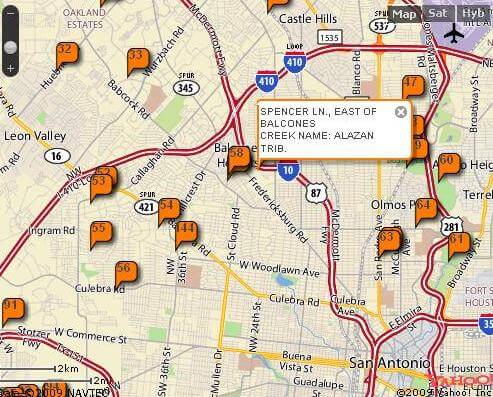
Kelly Guckian, the database editor for the San Antonio Express-News, produced this interactive Yahoo! map showing low-water crossings in San Antonio. During this week’s rare stretch of downpours in South Texas, this map is a potentially life-saving resource for people who want to zoom in on their neighborhoods or other parts of town to check out dangerous, flood-prone areas.

Using public data to uncover hidden stories

Saturday, January 3rd, 2009

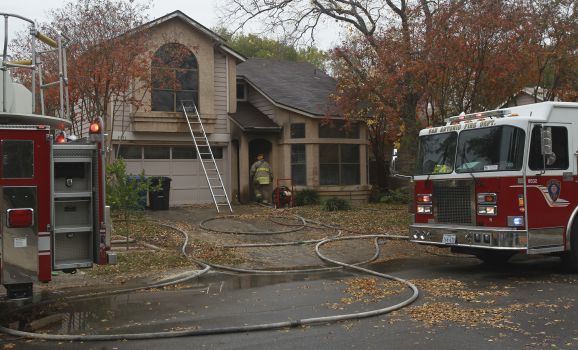
It took firefighters more than 11 minutes yesterday to reach a raging fire that destroyed a $1 million home on the outskirts of San Antonio. The national firefighting standard is a five-minute response time.

fire2Express-News readers know this is not a new problem in San Antonio.

After retired state Sen. Frank Madla and members of his family died in a fire in November 2006, the tragedy raised an obvious question: Are San Antonio firefighters doing a good job arriving to fires quickly and keeping residents safe? Express-News Projects Editor David Sheppard asked us to find out.

At this point, what would you do to get the story? Maybe call the Fire Department and ask them for quotes and statistics? Talk to homeowners to get anecdotal evidence?

In the old days, those were the methods journalists were stuck with. We wouldn’t be able to write anything beyond a superficial story. We wouldn’t truly understand the scope of the problem.

The rise of the computer age has helped reporters take the initiative to do their own analysis of public records. Journalists are analyzing government data to come up with their own findings and discoveries. It takes time and patience. But these new reporting techniques are uncovering compelling stories that are a public service and can’t be found anywhere else.

For the fire story, we asked the city for a copy of its entire database of incidents documenting responses to structure fires in San Antonio. The database showed the location of each fire and how long it took firefighters to arrive.

With the help of Express-News Database Researcher Kelly Guckian, we plugged the incidents and response times into a citywide map. Here’s part of the story I wrote with Guckian and Reporter Karisa King:

City records show the Fire Department’s mission of protecting lives and property is clashing with San Antonio’s appetite for new land.

In the past six years, firefighters rushed to inner-city blazes far more quickly than to fires in popular outlying areas that attract thousands of new homeowners.

Delays on the city’s edges plague rich and poor alike, from the exclusive enclave of the Dominion to low-income neighborhoods like Sunrise, a struggling community on the far East Side.

San Antonio annexed many of these neighborhoods despite protests by residents, who complained the city would fail to provide swift fire protection.

The city’s own records reveal that most of the time, those fears came true.

dominionfire2The analysis of the data took the story in whole new directions. When we sat down with fire officials to interview them, we didn’t have to start out by asking, Is there a problem with response times in San Antonio?

We already knew there was a problem. We showed them copies of our maps, told them what we found out from their database, and asked them, Why are firefighters taking so long to reach fires on the outskirts of the city? It changed the entire dynamic of the interview.

Many newspaper critics complain that reporters don’t simply “report the facts.” Maybe these critics would have a problem with journalists taking the initiative to conduct their own analysis of public data.

I would counter that our job is to tell readers what’s really going on. And by making sense of public data and asking our own questions, we are finding stories that help readers make sense of a complicated world.

At a time when newspapers are struggling, these kinds of public-service stories might save them.