Posts Tagged ‘Journalism’

San Antonio Express-News launches paywall

Sunday, May 5th, 2013

San Antonio Express-News building

Photo credit: Sean McGee

Our new paid site was unveiled today. We still have the free site at Mysanantonio.com that will offer things like breaking news, entertainment and event calendars. But in-depth stories and other features will now be tucked behind a paywall at Expressnews.com.

I’m not sure how I feel about paywalls on news sites, but I see some upsides. Thanks to the paywall, we don’t have to chase page views, so there’s no link bait or bikini-babe slideshows. There’s no extra cost for print subscribers, which rewards them for buying the newspaper. And the new site looks drop-dead gorgeous. It’s actually a pleasure to read without the distracting flash ads.

This is an interesting strategy. Mysanantonio.com will be free and post potentially viral content, while Expressnews.com will, hopefully, generate revenue from subscribers.

What do you think?

Texas Week examines dangers facing oil-and-gas workers on the Eagle Ford Shale

Sunday, February 24th, 2013

Watch February 22, 2013 | Eagle Ford Safety Issues on PBS. See more from Texas Week.

Many thanks to Rick Casey, Bruce Kates and the folks at KLRN’s Texas Week for inviting me to discuss the dangers facing oil-and-gas workers on the Eagle Ford Shale. At least 11 workers have suffered horrible but preventable deaths since 2009.

How to make stunning time-lapse videos: Q&A with photojournalist Tamir Kalifa

Monday, January 14th, 2013

Freelance photojournalist Tamir Kalifa spent two days working on this stunning time-lapse video of the Texas Legislature’s opening day for the 83rd legislative session. Lawmakers convene in Austin every two years and the event is widely covered by the media. But Kalifa, an intern at the Texas Tribune, captured the energy of the day in a unique, compelling way. I called him to ask how he did it.

Q: This is actually the second time the Texas Tribune has done a time lapse of the opening day of the Texas Legislature.

A: Yeah, that’s correct.

What were you trying to convey in this particular video and how does time lapse help you do that?

Tamir Kalifa

Kalifa

Well, I think that during the off year, the Texas government is sort of hibernating and waiting for this huge burst of energy that happens in the first few months of the year. So really what I wanted to show was the Legislature sort of waking up and coming to life and the excitement that everybody — from the legislators to the lobbyists to the lawyers to everyone’s families — I wanted to get across how people are hugely involved. I just thought doing a time lapse was the most efficient way to show the enormous scale of it. There were thousands and thousands of people swarming around the Capitol. There was an enormous line waiting to get into the House chamber to hear Joe Straus, to see him sworn in again.

It was amazing. I’m a musician in Austin. Free Week is just coming to a close now. You had all these free shows and everybody is clamoring to get in. It’s one in, one out when it gets to capacity. I realized, as I was desperately trying to get into the House to just get a little glimpse of it, there are a lot of Texans who get that kind of enjoyment and excitement out of the government. And that’s awesome. I really wanted to show that and kind of show the grandeur of it. There aren’t that many things in Texas that are as old as the capital. So it’s also cool to showcase it in that way.
(more…)

How to create maps and charts with Google Fusion Tables

Monday, October 15th, 2012

The friendly folks at the Association of Health Care Journalists held a conference last week in San Antonio, and they invited me to present an introduction about Google Fusion Tables.

If you’re familiar with Microsoft Excel or Access, you might like Fusion Tables. It’s a free tool that allows you to create interactive maps and charts with data. For journalists, this is fantastic. Fusion Tables unlocks the data stuck in your hard drive and lets you easily share it with readers in a compelling format. Check out some great examples at Matt Stiles’ blog, the Daily Viz.

If you’re interested in learning more, check out this slideshow for a step-by-step tutorial about some of the basics.

How to solve impossible problems: Daniel Russell’s awesome Google search techniques

Thursday, June 21st, 2012

Daniel Russell stood in front of a crowd of investigative journalists in Boston last week and showed us this picture of a random skyscraper in an unknown city:

Google challenge by Daniel Russell

Russell posed a riddle:

What’s the phone number of the office where this picture was snapped?

Let that sink in. He wasn’t asking for a phone number for the skyscraper in the picture, which sounds hard enough. He wanted the phone number of the precise office where the photographer was standing when the picture was taken.

Nothing in that office was even in the photo. Yet in a few minutes, Russell, a research scientist at Google, revealed the answer by paying attention to small details and walking us through a series of smart Google searches.

Daniel Russell, research scientist for Google“Once you know these tricks, you can solve problems that look impossible,” Russell said.

There are plenty of Google search cheat sheets floating around. But it’s not often you get to hear advice directly from someone at Google who offers you his favorite search tools, methods and perspectives to help you find the impossible.

Here are some of my favorite tips shared by Russell at the 2012 Investigative Reporters and Editors conference. Some of these techniques are powerful but obscure; others are well-known but not fully understood by everyone.
(more…)

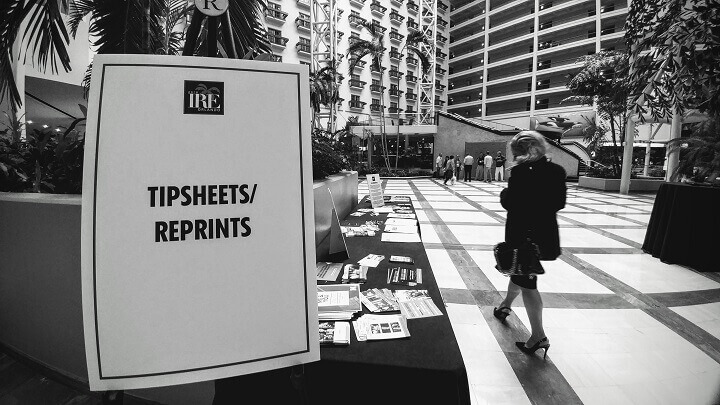
Live-blogging the IRE 2012 Conference in Boston: Resources that will help you be a better investigative journalist

Thursday, June 14th, 2012

IRE 2012 Conference in BostonThe classic stereotype about journalists is that we’re all backstabbing vultures who would sell our mothers for a good story.

Nothing could be further from the truth. First of all, we only sell our mothers for really, really good stories. But more importantly, we’re actually an amazingly friendly, collaborative bunch.

I’m in Boston where more than 1,000 people are trading tips, offering advice and learning from the best journalists around at this year’s Investigative Reporters and Editors conference.

This is the place to be if you’ve ever wondered, say, how Washington Post reporters figured out the complexities of the Jack Abramoff lobbying scandal. You get to listen to the actual reporters who worked on the story. They’re essentially saying, “Here’s how we did it, and here are some tips we learned to help you work on the same kind of story.” It’s a goldmine for anyone who cares about journalism and wants to do it better.
(more…)

Nickel and dimed: Find out which gas stations have faulty pumps that overcharge motorists

Sunday, June 3rd, 2012

Valero Station in San Antonio

If you’ve ever suspected your neighborhood gas station is stiffing you at the pump, you might already know you can file a complaint with the Weights and Measures Program at the Texas Department of Agriculture. The agency’s inspectors verify the accuracy of gas pumps.

But which stations rack up the most complaints, flunk the most inspections and cost consumers the most money?

The answers to those questions lurk within inspection data collected by state employees. The information is public. But like many government agencies, Weights and Measures hasn’t been analyzing its own data to look for trends that could help consumers make informed decisions.

So Express-News Data Editor Joe Yerardi downloaded a publicly available copy of the inspection data and took a look at it for himself.

The result was an interesting Sunday story that told readers things that state officials probably should have known themselves.

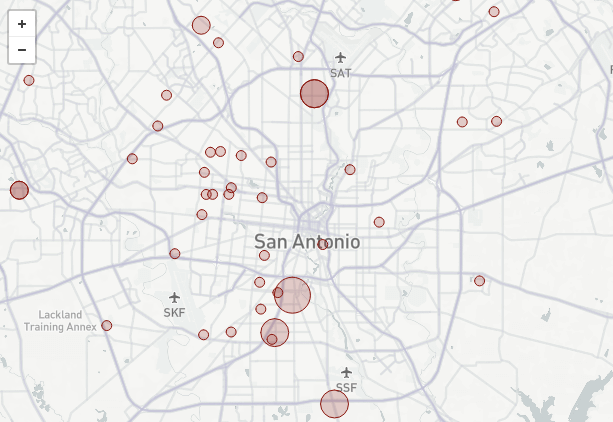
Joe learned that one out of five stations in San Antonio had at least one pump that failed inspections. The pumps that are more likely to shortchange customers are owned by one of the biggest players in town: Valero Energy Corp.

Joe mapped the locations of the stations and their inspection results, so anyone can check out the track record of their neighborhood gas station.

Joe told me it took nearly four weeks to work on the story. One of the difficulties he faced was sharing what he learned with state officials, who hadn’t analyzed their own database of inspection reports.

“It’s not their job,” Joe said, describing the bureaucratic mentality of some government workers. “It’s not what they’re paid to do.”

Not every government agency is like that, but it’s not an uncommon problem. When I found a San Antonio police database that documented every vehicle pursuit involving officers, I was a bit surprised to learn that SAPD had never analyzed the information, even though it shed light on an important public policy issue.

These agencies probably paid some poor data-entry monkey to go through each paper report and type the details into a spreadsheet or database. Why not go the extra step and analyze that information?

Joe described these kinds of stories as “low-hanging fruit” for journalists, who can step in and analyze databases that agencies aren’t scrutinizing.

“If they would go above and beyond their actual jobs, there’d be less of a need for reporters,” he said.

(Photo credit: Derrich on Flickr)

How two small-town reporters in Kentucky took down a corrupt sheriff

Sunday, May 20th, 2012

Journalists Adam Sulfridge and Samantha Swindler were both in their 20s and working for a small newspaper, the Times-Tribune in Whitley County, Kentucky, when they began investigating rumors about Sheriff Lawrence Hodge and his ties to drug dealers.

Federal agents had investigated Hodge in the past but their inquiry fizzled. The sheriff was too insulated and powerful. People were afraid to talk. The feds thought Hodge was untouchable.

He wasn’t.

Check out this fantastic 60 Minutes video about how two young journalists were able to do what the feds couldn’t — bring down a corrupt sheriff.

Sometimes Plan B is better than Plan A

Tuesday, May 1st, 2012

I shot some video over the weekend but it was so windy most of the audio was obliterated. So I ended up making a music video.

It wasn’t exactly what I planned. But maybe it was better.

How Mexican cartels launder drug money in San Antonio (Hint: Check the North Side)

Thursday, April 19th, 2012


View Larger Map

Maggie’s was the place to go in the 1990s if it was late and you were a hungry college student (like me). Nestled among the car dealerships on San Pedro Avenue outside Loop 410, the two-story restaurant was open late and offered some of the best shakes ever.

Maggie’s permanently closed, reopened as a Champ’s restaurant, closed, then reopened in 2009 as Barbaresco Tuscan Grill and Enoteca, a swanky Italian restaurant.

Barbaresco was a lot different from Maggie’s. On its opening day, guests were treated to readings of Romeo and Juliet while an attractive, semi-nude woman lay on a table, her body strategically covered with pasta.

Brothers Mauricio and Alejandro Sánchez Garza had bought the old Maggie’s restaurant, along with numerous other businesses and properties in San Antonio, and heavily invested in it. Now the Drug Enforcement Administration has accused the brothers of using those businesses to launder millions of dollars in drug money from Mexican cartels.

Express-News reporters Jason Buch and Guillermo Contreras wrote about the money-laundering case in a story published Sunday. The article detailed key properties and businesses the brothers were involved in, which is a hell of a way of grabbing readers’ attention. A lot of people like me remember Maggie’s. Finding out the building is tied up in a federal money laundering investigation definitely piqued our interest.

“It allowed us to see, literally see, how everything was connected.”

I sit next to Jason in the newsroom so I talked to him a bit while he worked on the story. One difficulty he faced was keeping track of the tangled spider web of people, businesses and properties connected to the Mexican brothers. To make sense of everything, Jason used a plugin for Microsoft Excel called NodeXL, which allows you to create a social network diagram.

Jason typed in more than 250 entities and their related entities in a spreadsheet, and NodeXL displayed that information in a graph that showed spokes between each connection. Here’s an example of the main players and entities:

Money laundering social network analysis

“It allowed us to see, literally see, how everything was connected,” Jason told me.

In complicated stories with lots of moving pieces, building a chronology to keep track of key events is also important. By chance I learned about a new open source, interactive timeline tool by Zach Wise and told Jason about it. Timeline is also based on information contained in a spreadsheet. In Google Docs, you type in the dates and chatter, provide links to photos, videos, or other media, and then Wise’s Timeline tool uses javascript to display an interactive chronology that you can publish on a website.

Jason and Guillermo were going to have to write a chronology in their notes anyway. Wise’s Timeline tool let them share their relevant information with readers in a really compelling way. Their timeline looks drop-dead gorgeous. And they linked to federal documents in the timeline, so readers could see the allegations for themselves.

Maggie’s is long gone. But it was fascinating to see what became of it.