Posts Tagged ‘Journalism’

How some journalists are encouraging bloggers to republish their stories

Thursday, September 30th, 2010
This morning I posted a story about Bob Woodward’s new book that was entirely produced by journalists at the Guardian newspaper in London. Instead of warning me to stop pilfering their content, the friendly folks at the Guardian are happily letting me publish it — for free.

The Guardian offers a WordPress plugin that lets bloggers republish stories. In return, a Web advertisement automatically runs at the bottom of the post, and the money from the ad goes to the Guardian. It’s an interesting way to widen the Guardian’s audience and its advertising reach, especially at a time when some news organizations are erecting pay walls around their websites.

“One of the obvious pros for us is the wider distribution and therefore the influence of our journalism,” The newspaper’s lead developer, Matt McAlister, wrote in an e-mail to me. “This tool is helping us to reach out to people around the world via the influencers who have a particular view to add and a desire to amplify the things that we publish. And if that works the way we hope it does then we will also form a high value ad network to offer commercial partners.”

One of the plugin’s nifty features is how it gives you access to the Guardian’s news feed right in your WordPress panel. It’s your own personal, searchable library of thousands of stories:

Guardian WordPress Plugin

You can also browse by topic, and by the type of article, blog post, podcast, slideshow or other features.

You might notice I’m a few months behind in blogging about the plugin, which was released over the summer. That’s because until recently, it didn’t work for me. First there was a problem with my version of php. And once that got fixed, I couldn’t get access to the news feed. The Guardian’s Daniel Levitt was very responsive when I first asked for help back in July. But the mysterious problem didn’t get sorted out until recently, when a plugin update finally allowed me to use it.

Also, some stories in the news feed aren’t available. When I tried republishing a story about the WordPress plugin, I got an error message that stated: “We are very sorry, but that particular article is not available for redistribution.”

So the plugin offers cool features to share stories, but some bloggers might run into technical difficulties with it. Nonprofit news sites ProPublica and The Texas Tribune offer an easier-to-use “republish” method that allows bloggers to simply cut and paste the material. You don’t get a news feed this way, but it’s quick and painless.

“We love the ProPublica copy/paste feature and think it would make a lot of sense to offer that capability, too,” McAlister said.

The Guardian’s plugin is an interesting experiment. Instead of complaining about readers’ expectations to get news online for free, the Guardian is trying to figure out how to share free content, widen their audience, and make money, too.

Maybe it will work. Maybe the effort will fizzle. But it beats wringing our hands and yearning for the good old days.

From surgeon to bank robber: What caused Dr. John Christian Gunn’s fall from grace?

Monday, September 20th, 2010
Story about Dr. John Christian Gunn in the San Antonio Express-NewsA few months ago, the Texas Medical Board sent out a routine public notice listing doctors who have been disciplined. One name in the list stood out to Express-News Medical Writer Don Finley: A San Antonio surgeon, Dr. John Christian Gunn, had lost his medical license after being convicted of a felony.

Finley checked it out and discovered Gunn — a Yale-educated surgeon — had robbed a bank in Austin.

“I’ve been watching doctors do lots of bizarre things for many years, but robbing a bank was new,” Finley told me. “It seemed like a very, very strange and tragic thing.”

The spark of curiosity about Gunn led to weeks of reporting by Finley, who talked to dozens of people and dug up public documents to piece together a story about the little-known doctor. Some of the best news stories are born this way: Simply asking, “Why?”

“To me, it’s the perfect narrative,” Finley said. “Why would a well educated surgeon rob a bank?”

Finley is a skinny, graying veteran of the newsroom best known for his deadpan wisecracks and his gift for writing about complicated topics. To really understand Gunn’s story, Finley read every public record he could get his hands on. At one point, he flew to Kentucky, where Gunn had once worked, to dig up court records. He found a medical consultant’s report that described Gunn’s track record as a doctor. There was also a bankruptcy case in Texas and other documents Finley obtained at the University of Texas Health Science Center at San Antonio.

Don Finley, medical writer for the San Antonio Express-News

Finley

Finley’s story ran last week and it has some striking quotes about Gunn. “He in my opinion was not a very good physician. Honestly, I think he did not have much sympathy or empathy for patients and their families,” said Dr. Joseph Miller of Arkansas.

But it took a lot of work to get people to open up.

“Almost nobody wanted to talk about this guy,” Finley said. Most potential sources were afraid of Gunn’s temper.

But the weeks of reporting paid off. To me, this is why journalism is so cool — you get paid to find stuff out, satisfy your curiosity, and learn something interesting about the world that no one else knows.

And then you get to share it on the front page of the Sunday paper with thousands of your closest friends.

Beware the evil media Hamster Wheel

Wednesday, September 15th, 2010
the media Hamster WheelToday’s must read is a bleak but compelling piece in Columbia Journalism Review by Dean Starkman, who examines how downsized news organizations are churning out mindless, quick-hit stories with little regard for depth and public service journalism. He gives the phenomenon a name: the Hamster Wheel:

The Hamster Wheel isn’t speed; it’s motion for motion’s sake. The Hamster Wheel is volume without thought. It is news panic, a lack of discipline, an inability to say no …

Journalists will tell you that where once newsroom incentives rewarded more deeply reported stories, now incentives skew toward work that can be turned around quickly and generate a bump in Web traffic …

None of this is written down anywhere, but it’s real. The Hamster Wheel, then, is investigations you will never see, good work left undone, public service not performed.

To some degree, the Hamster Wheel has always plagued news organizations but it’s getting worse. Starkman quantifies the damage — more stories are being cranked out by fewer journalists at the Wall Street Journal, for example, and time-strapped reporters are relying more on public relations spin.

The scariest part about the Hamster Wheel? It is a structure of our own making — no one is forcing journalists to get on the wheel. But we suffer from a misguided notion that we have no choice.

(Photo credit: sualk61)

Buy an online subscription, avoid being plagued by online ads

Monday, September 13th, 2010

advertisementLittle Green Footballs is making an interesting offer to its online community: Pay $10 a month as a subscriber, and you’ll get to visit a cleaner, faster, ad-free version of the blog:

This isn’t just a cosmetic improvement; to display those ads from Google Adsense and Amazon, we have to make several calls to external web servers, which take quite a bit of time. And if those servers are slow or offline, it can cause the entire LGF page to load more slowly or even time out on rare occasions.

When you view our site with advertisements turned off, every page loads more quickly; it’s a very noticeable speed boost. (And as the designer of this mess, I have to say it looks a lot nicer too without the visual clutter.)

So, for the very low price of about 33 cents a day (less than the cheapest cup of Starbucks coffee), you can read LGF without the ads, at super-charged speed.

Maybe newspaper websites, which are often bogged down with ads, could benefit from this kind of revenue model. If outright paywalls don’t work, give loyal readers a chance to pay for a premium service. Would you pay good money for the luxury of an ad-free newspaper website?

I think I just might.

(Photo credit: Pink Ponk)

New ways to cover breaking news

Thursday, September 9th, 2010

I got a cool e-mail yesterday from Justin Grigg, news editor for the Missoulian newspaper in Montana. “I recently bought an Android phone and stocked it with apps based on some of your blog posts. Little did I know I’d get to use Qik in the field so soon – I streamed live footage of a bear up a tree in downtown Missoula, Mont.”

Here’s the news story and one of the videos. “We started out with a link to the live stream from a breaking news story about the bear downtown. People in the office tweeted about the story and live stream,” Justin wrote.

The video showed how authorities managed to capture the bear without hurting the wild animal. It’s a good example of how a smart phone can be an amazing tool when you’re covering breaking news. Apps like Qik let you broadcast a video as the news happens. Awesome. Glad it was useful, Justin.

Uncovering hidden ties between state Rep. Jose Menendez and a housing developer

Monday, August 30th, 2010
News story by Karisa King

After Reporter Karisa King began writing about the complicated world of tax breaks for housing developers — and how those incentives are being abused — tipsters told her to check out state Rep. Jose Menendez.

Karisa did. And what she found out was published on the front page of last Sunday’s San Antonio Express-News:

After the development firm NRP Group LLC lost its second bid for tax credits to finance an affordable-housing project on the city’s West Side, an influential ally intervened in the company’s cause.

State Rep. Jose Menendez took the lectern at the Texas Department of Housing and Community Affairs and urged board members to fund the San Juan Square II project, a 144-unit apartment complex that would replace blighted public housing. …

What Menendez did not tell the board at the meeting was that the development represented something else: a financial boon for the company he works for, Stewart Title, which had received $91,000 for issuing title insurance on the project’s first stage, and landed nearly all of NRP’s business on affordable-housing deals.

Payouts from the San Juan developments were among about $1.8 million paid to Stewart Title from NRP housing deals since 2003, records show.

Since joining the Legislature in 2000, Menendez has been one of the most outspoken supporters of NRP and other developers in the affordable-housing sector.

At the same time, the San Antonio Democrat has ascended the ranks of Stewart Title to become vice president for commercial development in the company’s national division.

Karisa said she spent six weeks working on the story about Menendez. It was easy to confirm that he worked for Stewart Title. But his ties to the company raised a hard-to-answer question: How much money did Stewart Title make from the housing deals? That’s not something you can answer by Googling it.

Sometimes journalism is simply the act of quantifying something. You might know the broad outlines of a story very early in the reporting process, but you have to figure out how to fill in the gaps.

If you’ve ever bought a house, you know real-estate transactions churn out tons of paperwork. Normally most of those records are private. But because tax breaks were involved in the housing deals Karisa was looking at, the real estate records were considered public information, open to anyone who asked.

Karisa found the fees paid to Stewart Title by driving to Austin and reading the records for housing projects that receive tax breaks, which are filed at the Texas Department of Housing and Community Affairs in Austin. “I spent two days just going through boxes and boxes of documents,” Karisa said.

As she read through the files, Karisa typed key information such as the title fees into a simple Excel spreadsheet. After days of work, she was able to add up the fees for each housing project: A grand total of $1.8 million in title fees were paid to Stewart Title.

What did Mendendez have to say about that? Check out the whole story, it’s a great read.

Time magazine: Not for kids anymore

Tuesday, August 24th, 2010

The interviews with the kids are classic.

Warning labels for journalists — and bloggers

Monday, August 23rd, 2010
Journalism Warning Label

Painfully funny “journalism warning labels” created by British comedian Tom Scott are going viral. The stickers say things like, “Warning: This article is basically just a press release, copied and pasted.” Scott says he’s been posting the stickers on the free papers in London. And he’s making it possible for everyone to do this. You can download the stickers for free. Fans have translated them into 11 languages.

“It seems a bit strange to me that the media carefully warn about and label any content that involves sex, violence or strong language — but there’s no similar labeling system for, say, sloppy journalism and other questionable content,” Scott explained on his blog.

Scott’s making a salient point, but I don’t see why it should be limited to journalists. You can find rehashed press releases on blogs, too. That’s what a block quote is for. And contrary to what Scott claims, when I get an unverified tip, I don’t hang up the phone and start writing a story; I check it out. But some bloggers will simply run with it, then add the caveat that they’re waiting for confirmation. If it’s not true … oh well.

I’m not pointing this out to thump my chest and say the mainstream media should be trusted over everything else. But lately I’ve been noticing similarities between news organizations and many blogs claiming to be different from the media. For example, the Washington press corps is often accused of practicing pack journalism. Whenever some official announcement is made at the White House, everyone jumps on it and writes the same thing.

What’s so different about pack journalism in Washington and pack journalism in the blogosphere? Whenever an official announcement pops up from Google in my RSS reader, minutes later tech blogs are parroting it. Pick your niche; the same thing is happening.

The lesson here is that a blogger faces similar pressures and time constraints as a traditional reporter. It’s easy to make sloppy mistakes, to follow the pack, to rehash stale news.

The real challenge, for both blogs and the media, is doing something different, original, and enlightening for readers.

(Photo credit: Tom Scott)

Why is open government such a big deal?

Wednesday, August 18th, 2010

Some readers — and government officials — wonder why journalists are so nosy and make such a big deal about getting access to government records. Sure, transparency matters. But why make such a big fuss if an agency wants to withhold e-mails or something. Who cares?

Here are five shining examples of why this pesky-open government thing matters.

Last week, the Freedom of Information Foundation of Texas held its annual conference in Austin and announced the winners of the Gavel Awards, which go to journalists who produced stories that shed light on the legal system. A common thread runs through all these stories: They relied extensively on public documents, and uncovered important, previously unknown problems and issues in the community.

So if you think public information isn’t really that big a deal, check out the winning stories:

  • Steve Thompson and Tanya Eiserer of The Dallas Morning News discovered the Dallas Police Department was under-counting serious crimes, creating the perception that the city was safer than it actually was. The reporters uncovered the story by examining piles of police reports.
  • Jeremy Roebuck and Jared Janes of the McAllen Monitor relied on public documents to tell the tale of how Hidalgo County was struggling to pay for millions of dollars in indigent defense costs. The reporters discovered the county’s system cost more per capita than any other urban county in Texas.
  • Leslie Wilber of the Victoria Advocate revealed how an innocent man was jailed for 62 days based on a questionable “scent identification lineup” overseen by a dog handler and his bloodhounds. The obscure law-enforcement technique answers to no laws or regulations and critics call it junk science. But the lineup is still admissible as evidence in court.
  • Cindy V. Culp of the Waco Tribune-Herald used court data to analyze the track record of a district attorney running for office. The news stories gave voters a clearer picture of a controversy surrounding how many criminal cases were dismissed.
  • David Schechter and Mark Smith of WFAA-TV uncovered how illegal immigrants who are accused of felonies in the United States — including murder — are routinely deported back to Mexico and set free.
  • Somebody explain to me again why public information doesn’t matter.

    Untold stories: What happens when good reporters leave the news business

    Monday, August 2nd, 2010
    Controversy at Holy Cross High SchoolA week ago, Jenny LaCoste-Caputo wrote a front-page story about Holy Cross High School, and how it withheld diplomas from students who owed thousands of dollars in tuition.

    This week, Jenny is on her way to a new job in a new city. She’s leaving behind the news business and all its uncertainty.

    “It was getting scary,” Jenny said, referring to round-after-round of lay offs in the turbulent media industry. “We got two little kids.”

    When a journalist leaves journalism, it’s easy for the bean counters to figure out how much money is saved in pay and benefits. But it’s difficult to calculate the lost impact of all the great stories that will probably go untold by a single talented reporter.

    Jenny covered the education beat. She first learned of the problems at Holy Cross in May through a tip. She began talking to “as many people as possible” to vet the complaints about Holy Cross, and she went back and interviewed families to make sure they didn’t change their stories. The didn’t. “It’s not like we took things at face value,” Jenny said.

    Here’s the top of the long article Jenny wrote after weeks of work:

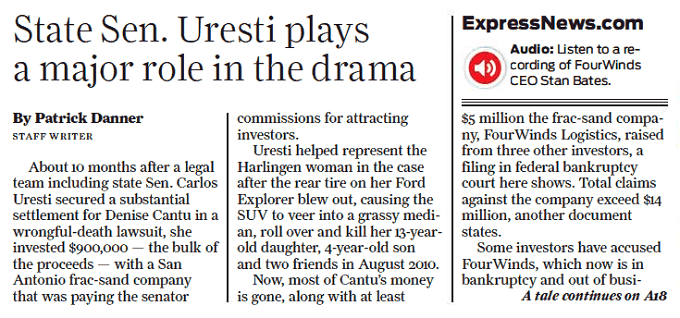
    For Sylvia Flores, a private school voucher seemed like a winning lottery ticket.

    Flores lives in Edgewood Independent School District but desperately wanted a Catholic education for her son, Luis Flores.

    It was a dream that was out of reach until she heard about a voucher program funded by San Antonio businessman James Leininger, who spent 10 years and $50 million of his fortune bankrolling a political idea that never caught hold in Texas.

    When the voucher program ended after her son’s sophomore year at Holy Cross of San Antonio, Flores was left with a gut-wrenching reality: She couldn’t afford the school Luis loved. But she said that when she opted for public school, Holy Cross’ principal urged her to stay, offering tuition assistance and opportunities to work off the $5,100 in annual tuition.

    Ultimately, staying cost Luis his diploma and left Flores with a bill of nearly $10,000 she didn’t expect.

    Four families whose children were scheduled to graduate from Holy Cross this year told the San Antonio Express-News that the school’s administration encouraged them and others to remain at the school despite mounting bills, promising help with tuition. But in the second half of the students’ senior year, school officials told the families they would have to pay their tuition bill in full if they wanted their children to graduate. The bills ranged from $6,300 to nearly $14,000.

    A teaser for the story was posted online and it generated more than 100 comments before the full article was even published. One thing Jenny learned is that several of the students were athletes, and Holy Cross didn’t raise concerns about their tuition until the sports seasons were over.

    “In almost every case, that was what happened,” Jenny said.

    Jenny Caputo

    Caputo

    Express-News Editor Bob Rivard mentioned the Holy Cross story in a newsroom meeting Thursday, where we all said farewell to Jenny and three other journalists who are moving on to other jobs or going back to school.

    Reporter Elizabeth Allen also left the paper, and the conversation at the meeting turned to the memorable reporters like Elizabeth who came to the Express-News after covering news in the Rio Grande Valley. Maro Robbins, Jeanne Russell, Bonnie Pfister … they all wrote outstanding stories. And they’ve all left the news business. It’s sobering to think of all the great stories that are going untold in San Antonio. Not to sound like Donald Rumsfeld, but we don’t even know what we don’t know we’re missing.

    Bob said as much during the meeting. While some news executives claim we can do less with more, Bob said he didn’t buy that.

    “Make no mistake,” Bob told the departing journalists last week, “by losing you, we are diminished.”

    In the age of Facebook and Twitter, you could argue that even though we’re losing some talented voices in the media, in the long run it’s OK because the Internet allows all of us to tell stories. But that argument doesn’t take into account the quality of the stories. Jenny’s article was rich with telling details, which she dug up during weeks of work. That kind of time is a luxury for most bloggers. And that kind of depth is a far cry from a rant on Facebook.

    Jenny’s husband, Anton, had covered the environmental beat at the Express-News, and led our coverage of the controversy surrounding the proposed expansion of the nuclear power plant in Bay City, Texas. Anton got a job in Austin and left journalism — and Jenny’s doing the same, working for the Texas Association of School Administrators.

    “I’m glad I’m going out on a high note with a story that made some impact,” Jenny said.

    Imagine the other high notes if she had stayed.