Posts Tagged ‘San Antonio Express-News’

A news show without the yelling: Rick Casey hosts ‘Texas Week’ on KLRN

Sunday, January 23rd, 2011

Watch the full episode. See more Texas Week.

Houston Chronicle columnist Rick Casey — formerly a San Antonio Express-News columnist whose deeply reported pieces taught a young journalist named John Tedesco a thing or two — is back in San Antonio and trying something new.

Check out his new show on KLRN: “Texas Week.” The first episode aired Friday.

Notice the lack of weeping hosts, confusing flow charts on chalk boards, and people yelling at each other.

Refreshing, isn’t it?

How turmoil in San Antonio newsrooms spawned a new competitor: Plaza de Armas

Wednesday, January 12th, 2011
Plaza de Armas

When you hear about the massive downsizing of newsrooms across the country, usually the discussion focuses on the loss of institutional knowledge, or how readers are being asked to pay more for less, or how lay offs are a shortsighted way for newspapers to stay profitable.

All that is true. But the chaotic climate at newspapers is leading to another shoot-yourself-in-the-foot consequence: When newspapers shed staff and create uncertainty in newsrooms, they wind up creating new competitors who happen to be the very journalists they used to employ.

That’s what’s happening with a new online start up in San Antonio, Plaza de Armas. It was founded by Greg Jefferson, a former political writer for the San Antonio Express-News, and Elaine Wolff, the former editor of the San Antonio Current, the city’s alternative weekly.

The website’s official launch was today. It’s the first local news site in San Antonio that will try to stay profitable through an online subscription model. Subscribers will pay $5.99 a month or $60 a year for exclusive content.

Elaine and Greg weren’t laid off by their employers like so many of our colleagues. But the survivors of today’s newsrooms must ask themselves some tough questions: Do we have a future at our publication? Is this still a place where we can do good work? Is it time to move on?

We all come up with our own answers, and Greg and Elaine reached the conclusion it was time to strike out on their own. They might be successful. Or they might fail. But they decided to take a chance, and now the Current and the Express-News are going to have to scramble to catch up with any scoops published by the well-wired news veterans at Plaza de Armas.

Plaza de Armas is an alternative voice that, overall, is good for readers. But it’s also an offspring of the turmoil at the Current and the Express-News. Now both newspapers have one more competitor to deal with.

Four women are in prison for a bizarre case of child abuse. Did they do it?

Friday, January 7th, 2011

All four women — the aunt, Elizabeth Ramirez, her roommate Kristie Mayhugh and two friends, Anna Vasquez and Cassandra Rivera — were found guilty of aggravated sexual assault of a child and indecency with a child.A great news story tells readers something new about the world in a compelling way. It’s even better if the reporter digs up the story through her own initiative. And it’s even better if the issue is so important or shocking that readers simply can’t put down the paper or — nowadays — their iPad.

Michelle Mondo’s bizarre story about four women who might have been wrongly convicted of molesting two girls certainly qualifies.

Michelle learned of the case when an essay about it was published in April 2009 in Texas Monthly. The author, a Canadian professor named Darrell Otto, had been surfing the Internet and found a 1998 Express-News article about four friends — Anna Vasquez, Cassandra Rivera, Elizabeth Ramirez, and Kristie Mayhugh — who were all serving long prison sentences for a strange crime:

Four young women in that city, acting on their own, had allegedly restrained and, in ritualistic fashion, sexually assaulted two girls, aged seven and nine, over two days. There was no physical evidence tying the women to the assaults, yet the newspaper reported the case against them without a hint of skepticism. It mentioned nothing about mental illness or confessions. Psychology-wise, the only point noted was that the women were lesbians, although academic research clearly shows lesbians are not predisposed to sexually abuse children. I was frustrated by the lack of information.

Otto was convinced the women had been wrongly convicted. Express-News Metro Editor Jaime Stockwell read the essay and asked Michelle to look into the case.

This wasn’t press-release journalism that critics of the media rightly complain about. Michelle spent 18 months on the story, whittling away at it in her spare time as a crime reporter for the Express-News. It wasn’t easy. When I stopped by her desk last week to ask her about it, the beeps and sporadic radio transmissions from the police scanners she was monitoring occasionally interrupted us. Try investigating a possible wrongful conviction when at any moment you have to drop everything and run out to a structure fire.

Michelle stuck with the story. She dug up old court records, tracked down family members, interviewed the convicted women, and waded through “accusations and counter accusations involving different famlies in different states,” she said.

Her findings were published on the newspaper’s front page:

A San Antonio Express-News investigation — including interviews with witnesses and experts and a review of police reports, medical studies and thousands of pages of trial transcripts and other court documents — raises troubling questions about the scientific legitimacy of medical evidence deployed against the women, whether authorities checked a previous rape allegation made by the girls and whether anti-gay views prejudiced Ramirez’s jury.

In two trials, the defense called no witnesses to rebut the testimony of pediatrician Nancy Kellogg, then as now the medical director of Child Safe — at the time, it was called the Alamo Children’s Advocacy Center. But research available when she examined the girls classified the three signs of sexual trauma she found as either normal, inconclusive or impossible to identify as a scar, as she did.

On and off the witness stand, the girls changed their accounts of the timing, weapons, perpetrators and other basic details of the assault every time they told it to authorities, records show.

The girls’ family was mired in conflict before and after the trials, with members making abuse claims in two Texas counties and in another state. It wasn’t the first time the nieces had made a rape outcry.

The trial of Ramirez, held separately from the other women, showcased her sex life, and her jury foreman, a minister, had told attorneys that homosexuality was wrong on religious grounds.

When Michelle interviewed the convicted women for her story, they maintained their innocence — and wondered where the media had been all this time.

“All four of them asked me, ‘Why was I doing the story now?’” Michelle said.

It’s a fair question. Had reporters failed to scrutinize this case in the 1990s when it really mattered?

I checked our news archives. There were about a half dozen stories about the trials, including one with the headline: “Defendants say accusers made up story of assault.” The stories described the crime as a gang rape. I couldn’t really find any in-depth coverage — the articles ran in the Metro section and the longest one I found was about 500 words long. At the time, I had been at the paper for about a year but today I don’t even remember the trials. It looks like the charges were part of the depressing, never-ending stream of twisted child abuse and murder cases in Bexar County that we keep having to write about. Most of the time, those heinous crimes really did happen. Most of the time.

This being Texas, Michelle is doubtful the women will be freed any time soon. But after the story ran, she’s heard from the women and their families. Maybe it’s too little too late, but it means something when a third party like Michelle comes in, spends a lot of time looking at the evidence, and publicly points out inconsistencies in a criminal case that shattered the lives of the defendants.

“For them, it was a very big deal for somebody to point out, ‘Wait a minute, these women aren’t what they were portrayed as,’” Michelle said.

After car wreck and lawsuit, what happened to Patrick Davis?

Wednesday, December 15th, 2010

This story was a sobering and perplexing look at the life of a young man who suffered a traumatic brain injury in a car accident. Patrick Davis made headlines when he sued General Motors for $50 million, but after the lawsuit was settled, the media moved on and forgot about Davis.

What happened to him? After digging through a thick file at probate court and conducting several interviews, I found some answers, but they led to new questions.

You can read the news story and click on copies of the court records that I annotated thanks to DocumentCloud, a great tool for adding context to primary documents.

You can also check out this interactive timeline on Dipity to trace the history of Patrick Davis, who still has his dry sense of humor after all these years.

Hearst execs meet with Express-News staff, discuss future of news biz

Wednesday, December 15th, 2010

I had the day off today, but with all the tweets coming out of an Express-News staff meeting this morning, it almost felt like I was there.

Executives from Hearst Corp., which owns the San Antonio Express-News, met with staff and answered questions about the future of the paper. Here’s an outline of what was said, courtesy of Storify:

Telling stories with data: Police chases and drug smugglers on the Texas-Mexico border

Friday, November 26th, 2010

After the Express-News and the Texas Tribune collaborated last month on a story about concealed handgun permits, Brandi, Matt and I were jazzed about the results and started talking about what to work on next. Here’s what we came up with: An analysis of nearly 5,000 vehicle-pursuit reports kept by the Texas Department of Public Safety.

Until recently, I had no idea this DPS database existed. But I stumbled across it a few months earlier when I was working on this article about pursuits in San Antonio. SAPD keeps a database packed with details about each chase — the weather and road conditions, the pursuit speeds and durations, the injuries and fatalities. Since SAPD had this data, I figured other law enforcement agencies in Texas probably kept similar records. I asked around and sure enough, DPS was one of the agencies that collects details about pursuits.

Why is that a big deal? Well, when you find a previously unknown database with information about an important public safety issue and analyze those digital records, you’ll probably discover fresh, interesting information for your readers. Public databases empower journalists to do their own research and find surprising answers.

Brandi asked for a copy of the data and we received it from DPS with little trouble. It was a big spreadsheet documenting nearly 5,000 pursuits from 2005 to July 2010.

One detail jumped out at us: Hidalgo County, by far, had the most pursuits over the past five years — 656. Several other border counties also ranked high, suggesting smugglers were often fleeing DPS troopers. The database told us all kinds of things about these pursuits — how often people were injured, how often motorists escaped, and how they got away.

When reporters dive into data-heavy topics, it’s important to find the real people behind the numbers. We asked DPS early in the reporting process to go on a ride-along with a trooper in Hidalgo County. Brandi and photographer Callie Richmond visited McAllen and went on a ride along with DPS Trooper Johnny Hernandez. Their experience became the lede of our story. Brandi had some great interviews with Hernandez and other troopers in Hidalgo County, who openly talked about their continual struggles to catch smugglers from Mexico. The visit provided rich material for photos and an awesome online video that Callie produced.

Brandi wrote a big chunk of the article on the drive back from McAllen. We finished writing and editing the story in a Google Document, which really beats sending e-mails back and forth and losing track of differing versions of the story. Google Docs lets you see what each collaborator is adding to the document as they write. It’s like the Big Brother version of Microsoft Word, but less evil. It’s a useful tool for collaborating with people, especially if they work in a different organization in a different city. Plus, Google gives you a chat window in the document, which is nice if you want to mock the typing skills of your colleagues.

Why bother teaming with the Tribune? I blogged earlier about how I’m warming up to the touchy feely trend of collaboration in journalism — how it helps overworked reporters tackle stories, and broadens their reach with a wider audience when the final product is published. When our story ran Sunday, it was published in the Express-News, the Texas Tribune, the Houston Chronicle and the New York Times.

The collaboration also helped us post online goodies for readers hungry for more information. Matt Stiles made an interactive county map of Texas. I used DocumentCloud to post this annotated copy of a pursuit report that offered context from the pursuit data. Callie’s YouTube video was a very cool mini-documentary that explained the issue. We also posted the data online, allowing readers to learn about pursuits in their own counties.

There were some interesting reactions to the story. Scott Henson at Grits for Breakfast was surprised so many suspects got away: “I would not have guessed that the number of chases ending with the suspect successfully eluding troopers on foot would have been so high, nor that the proportion who stop and surrender would be so low.”

KXXV TV localized the story by looking at the high number of pursuits in McLennan County.

That’s the great thing about news stories based on public data — people can take the information you found, talk about it, and look at the data themselves.

Express-News and WOAI team up for story about court-appointed lawyers

Tuesday, November 9th, 2010

Veteran observers of San Antonio politics experienced a deja vu moment the other night when a familiar story graced their TV screens. WOAI Trouble Shooter Brian Collister told viewers that Bexar County judges are using a flawed process to appoint lawyers to indigent defendants. If this story rings a bell, it should — Collister broke a similar story in 2002 about then County-Court-at-Law Judge M’Liss Christian giving David Garcia, a lawyer and city councilman at the time, most of Garcia’s indigent defense work at the courthouse.

This was an interesting fact, considering how Christian and Garcia were rumored to be a romantic item.

In 2002, the Express-News and other San Antonio news organizations scrambled to keep up with Collister’s bombshell coverage of Christian and Garcia. But for this more recent court story, Collister did something weird — the hyper competitive TV reporter asked if the Express-News wanted to team up.

How the heck did that happen?

It turned out Collister was working on his courthouse story around the same time Express-News reporter Brian Chasnoff was also digging into the issue. Last month, Chasnoff wrote a story about Bexar County’s erratic method of appointing defense lawyers to low-income clients. The story was based on a state report by the Texas Task Force on Indigent Defense, which determined that Bexar County was violating the Texas Fair Defense Act.

It was an important story. If you’re poor and accused of a crime in Texas, you’re entitled to a court-appointed lawyer. That lawyer is supposed to be randomly appointed to your case from a rotating pool of eligible lawyers. But in Bexar County, judges were appointing hundreds of lawyers who weren’t even on the approved list, and a small number of lawyers had amassed the most work and income.

The state report obtained by Chasnoff did not identify the lawyers who got the most work. But Collister had already obtained a county database that named names. It identified the lawyers receiving court appointments; how much they were paid; and the judges that gave out the work. A handful of attorneys were making hundreds of thousands of dollars.

This is where things get interesting.

In the old days, Collister would have done his own story in an effort to compete with the Express-News. But times have changed in journalism. There are fewer warm bodies in newsrooms, and while there’s still heated competition between news organizations in Texas, there’s also a new willingness to pool resources, collaborate on stories, and reach wider audiences.

So Collister approached the Express-News and asked if it wanted to team up for a detailed story about court-appointed lawyers.

“The idea was, ‘You have a piece of the puzzle, I have a piece of the puzzle. Let’s work together and make a better story,’” Collister told me. “The days of there being cutthroat competition, to a point, are over.”

It was an odd sight watching Collister hanging out in the Express-News, hovering over Chasnoff’s desk and collaborating like it was the most natural thing in the world.

I asked Chasnoff what it was like working with Collister. Chasnoff said he was pleasantly surprised. He didn’t encounter the heavy handed reporter on TV who shoves fuzzy microphones in people’s faces during ambush interviews. Collister had good ideas, and his court data saved Chasnoff a lot of time. Before they teamed up, Chasnoff had requested similar data from the county, so partnering with Collister meant Chasnoff didn’t have to waste time waiting for the information. “He had the goods,” Chasnoff said.

Chasnoff wrote a long news story that ran in the Sunday paper and WOAI produced its own version of the story. They identified the top lawyers and how much they were paid and posted the data online:

The top earner, lawyer Hilda Valadez, earned more than $400,000 in the past three years, hundreds of thousands of dollars more than the average court-appointed attorney.

In at least one courtroom, the inequity appears rooted in cronyism. Attorney Edward Adams, who contributed the most in the past year to the failed re-election campaign of County Court Judge Monica Guerrero, also was appointed the most cases and earned by far the most money in Guerrero’s court in the past three years.

Both news organizations brought different strengths to the table. WOAI told the story with pictures and audio, while the newspaper story went into greater depth and detail. Collister said he was pleased by the long, nuanced newspaper article. In most TV stories, he has to leave a lot of good material on the cutting room floor — that’s the nature of the beast in TV news, which is always crunched for time. So it was nice to have the newspaper story include points that he didn’t have a chance to air.

“To see it all get out there is just really gratifying,” Collister said.

I like news scoops as much as the next guy. But I’m starting to warm up to the notion that there’s a benefit to teaming up, every once in awhile, with other news organizations to pool resources and reach a broader audience.

Even after the stories ran, the teamwork between Collister and Chasnoff continued. The stories generated interesting tips from readers and viewers. Chasnoff said he and Collister have been sharing tips, and they might work on follow-up stories together.

“His attitude is, we stay unified,” Chasnoff said, “and we push the story forward.”

‘Wrong polling place? What polling place?’

Tuesday, November 2nd, 2010

Observations from Bexar County voters and Express-News journalists on Election Day:

Treasure Hunters Roadshow is completely different from ‘Antiques Roadshow’

Saturday, October 30th, 2010

Treasure Hunters RoadshowI was flipping through the “A” section of the paper Wednesday morning when I noticed a full-page ad for something called Treasure Hunters Roadshow. It was an “advertorial,” an advertisement designed to look like a news story. The headline declared: “Hundreds of people cash in at the San Antonio Roadshow yesterday!” The roadshow was holding an event from Tuesday to Saturday at the Wonderland of the Americas mall for anyone hoping to make some quick cash from unwanted antiques and old jewelry.

My first thought was a question: Is this the same thing as “Antiques Roadshow” on PBS? The fact that the ad was trying to mimic the credibility of a news story suggested it was a different outfit. But I didn’t know for sure.

Thanks to the miracle of Google, it took a few seconds to figure out that Treasure Hunters Roadshow is different from “Antiques Roadshow.” In fact, the producers of the PBS program had filed a federal lawsuit against Treasure Hunters Roadshow, complaining that it was tricking customers with the logo of a treasure chest, and the term “roadshow” in its name.

I asked my bosses if I could write a story pointing out the difference between the two roadshows, and they said go for it.

One of the great things about the Internet is you can quickly obtain primary documents. When I saw the references on some websites about the federal lawsuit against Treasure Hunters Roadshow, I logged into Pacer, a government website that offers public access to federal court records. Although the lawsuit was filed in Illinois, where Treasure Hunters Roadshow is based, through Pacer I could download the actual filings. Here’s the original complaint:

Roadshow

I drove out to the mall to check out the rival roadshow operation. There were scores of people, many of them elderly, holding boxes of heirlooms in a conference room. Employees in black polo shirts peered at items under bright lamps. I spoke to a few people and they said it was a fairly painless experience — no one was pressuring them to sell Uncle Ted’s dusty collection of baseball cards. One woman said she was sure the offers weren’t for the full market value of the goods, but she wanted to get some idea of how much money she could get for an old teapot.

I asked to speak with the manager and two guys, Jason Zyla and Keith Hammons, showed up. They were friendly, answered all my questions, and gave me unfettered access. They insisted that few customers mix up Treasure Hunters Roadshow with “Antiques Roadshow.” It used to happen — but not any more, they said.

They said their employees don’t use high-pressure tactics on customers, and they’ve written some large checks to people who brought in valuable antiques. They said they make fair offers, but are up front with customers that the roadshow has to pay expenses and make a profit, too.

“We don’t do this for free,” Hammons told me. “And I would tell anybody that, hey, we can’t give you one million percent of what it’s worth. You got to cut back a little bit, just for expenses.”

Although Treasure Hunters Roadshow holds events all over the country, not many media outlets note it’s an entirely different operation from “Antiques Roadshow” and the two parties are involved in a legal dispute. So I wrote a story with the goal of pointing out to our readers that there is a difference. Here’s the story and some of the websites I found:

Collaboration: A touchy feely buzzword in journalism that’s actually good for readers

Monday, October 11th, 2010

You might notice an odd byline on this recent story about concealed handgun permits published by the San Antonio Express-News. I worked on the article, but so did reporters Brandi Grissom and Matt Stiles, who work for the nonprofit Texas Tribune, an entirely separate news organization based in Austin. The same stories, video, maps and photo that ran in the Express-News also appeared on the Tribune’s website.

As scores of nonprofit, public-service media organizations sprout up around the country, “collaboration” is the latest buzzword in journalism circles. The gun-permit story was the result of the first collaboration between the Express-News, a daily newspaper established 145 years ago at the end of the Civil War, and the shiny new Texas Tribune, which launched nearly a year ago as a web-based source of Texas news and public data. The Tribune’s founder, venture capitalist John Thornton, believes in-depth journalism is a public good — but not necessarily good business anymore. So he joined forces with Evan Smith from Texas Monthly, made the Tribune a nonprofit that relies on donations, and hired top-notch journalists from other newspapers, such as Matt and Brandi.

The folks at the Tribune offer their content for free to anyone who wants to republish it, and they’re eager to collaborate with other news organizations. The Tribune got a cold reception at a few Texas newspapers, but my bosses were always open to the idea of teaming up with the Trib. Their attitude was, if there’s a good story and it makes sense to work together, let’s do it.

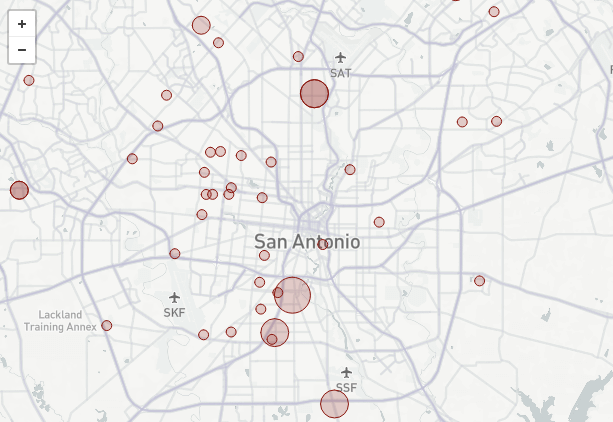
One idea was to write about data kept by the Department of Public Safety that showed how many concealed handgun permits are issued for every ZIP code in the state. When you view the data on a map, it shows the affluent North Side of Bexar County had higher rates of permits issued than neighborhoods close to downtown San Antonio, where crime rates were higher. It was a curious pattern that occurs in every major Texas city, and Matt asked if we were interested in teaming up on a story about it.

We started working together in early September. Before this project, I knew Matt and liked his work. I didn’t know Brandi personally but liked her work, too, especially this story and this story. And I liked how the Tribune got people excited about investigative journalism. The owners were building something new, not looking for new ways to downsize and cut costs like every other newspaper in the country. It was a nice change.

Brandi, Matt and I relied on conference calls, e-mails, and Google Documents to share material and ideas. Both the Tribune and the Express-News have talented staff who could have done this story on their own. But by teaming up, we were able to throw more people at the story, gather more information, finish it faster, and reach a broader audience. Matt called it a “force multiplier.”

One thing that worked well for us was having a clear division of labor. I did the shoe-leather reporting in San Antonio and interviewed gun instructors here; Brandi interviewed people and experts in other parts of Texas, and Matt handled the data analysis. I wrote some early drafts using Google Documents so we could all work on the stories. Brandi plugged in information she gathered and beefed up the articles, especially the one about the surge in gun permits during the Obama administration.

The Express-News benefited from this arrangement. If I had worked on the story by myself, maybe I would have thought to interview the gun owners, experts and public officials Brandi spoke with — but maybe not. And who knows if I would have had the time to do all that. And we also tapped into the power of the Texas Tribune’s awesome data library. By teaming up with the Tribune, the Express-News posted some cool interactive maps created by Matt. That’s a tangible feature that might not have been there for our readers if the Express-News handled the story by itself.

By teaming up with the Express-News, the Tribune got an extra reporter out of the arrangement and benefited from one of the primary strengths of the newspaper, which pays reporters to spend weeks or even months to work full-time on a story. I hung out at shooting ranges, attended two concealed handgun classes, shot some video, and interviewed gun owners and gun instructors.

All this time spent “hanging out” helped me collect telling details and colorful quotes that enriched the story, and I learned a lot about the issue. I liked how a folksy gun instructor, Michael Arnold, quoted the Chinese military genius Sun Tzu to tell his students the importance of using force as a last resort.

Several other Express-News staffers helped out. While I was at a shooting range, Photographer Edward Ornelas shot some cool photos — I love the shot of the shell casing flying out of a pistol. At the office, Database Researcher Kelly Guckian crunched crime data we had to add some context to the story. And graphic artists Harry Thomas and Michael Fisher used the maps created by Matt for the print edition.

What this all means is that in an age of shrinking newsrooms, collaboration briefly augmented the Texas Tribune and the Express-News. And the results most likely surpassed anything the two organizations could have accomplished on their own in the same time frame.

Pitfalls: Coordinating the data-heavy graphics was a bit of a pain. It’s not like Matt could simply walk across the Express-News newsroom and talk to our graphics people. It took some back and forth to get everything right. Maybe we stumbled upon an actual use for Google Wave to deal with that.

I asked Matt and Brandi, who left large corporate newspapers to join the more nimble and experimental Tribune, whether it was a pain dealing with mainstream newsrooms again. They said so far, so good. The gun story got pushed back a week because the Sunday print edition of the Express-News was jammed up with other stories. That’s not a problem the Tribune has to deal with. In this case we thought it was OK because it gave us some breathing room to keep working on the story and make it better.

Overall though, we’re pretty jazzed about the way it all worked out — and we’re talking about our next cool project.