Posts Tagged ‘San Antonio’

Reliving the Battle of the Alamo

Monday, March 11th, 2013

I got to spend Sunday afternoon with members of the San Antonio Living History Association, who reenacted the historic battle of the Alamo and showed onlookers what life was like 177 years ago. This was heaven for history buffs.

Road rage in Texas: Find accidents in your neighborhood with this interactive map

Monday, July 23rd, 2012


Full map
Crash with one or more injuries. Crash with no injuries.

Braylon Nelson is one of the sweetest kids you’ll ever meet. Like any other 2-year-old boy with an insatiable curiosity, he asks a million questions and loves stories. When I visited him, a 400-page book of fairy tales was on his bed near the medical equipment that helps him breathe and eat.

Braylon’s father was driving him home from daycare last year when a Ford F-150 crashed into their small Saturn SL2. Witnesses said the truck driver had been speeding during a dispute with another motorist, and police blamed the accident on road rage.

The Nelsons had nothing to do with the altercation, but Braylon was paralyzed from the neck down.

No other county in Texas has as many reported road-rage crashes as Bexar County. Police and sheriff’s deputies cited road rage as a contributing factor in 680 crashes from 2007 to 2011.

That’s according to a public database of every vehicle accident in the state. The information comes from police accident reports, known as CR-3 forms, and are compiled by the Texas Department of Transportation in a massive database called the Crash Records Information System.

The database tracks hundreds of details about each accident, and anyone can request this information from TxDOT. You can ask for specific locations or types of crashes, or request a copy of the entire database if you’re comfortable using spreadsheets or database managers. To get an idea of what kind of information is available, check out this TxDOT spreadsheet. Or you can read the annual reports of crash statistics published by TxDOT.

Why does Bexar County have so many road rage crashes? It’s unclear whether we have more angry drivers, or whether San Antonio police are more apt to cite road rage than officers in other jurisdictions.

When I met with police officials about these statistics, they said they couldn’t comment on the reporting practices in other cities. But about 12 years ago they recognized San Antonio had a growing problem with aggressive drivers, and police started a program in which officers drive in unmarked cars to catch speeders, tailgaters, and other unsafe motorists like the ones accused of paralyzing Braylon.

I’ve seen some crazy drivers in San Antonio, and when I was working on this story, it seemed like every day I saw someone driving like a maniac.

If you want to learn more about road rage, you can check out the data for yourself in this interactive map that shows crashes in your neighborhood. You can also download the raw numbers here.

Wrong-way crashes on San Antonio highways happen more often than you might think

Monday, June 11th, 2012

Wrong-way crashes in San Antonio flew under the radar

A few months ago, my boss, Express-News Projects Editor David Sheppard, asked me to see what we could find out about wrong-way crashes on highways. It seemed like there were a lot of these deadly accidents in the news lately, and local officials had recently unveiled a $500,000 pilot project to install flashing wrong-way signs and radar on a 15-mile segment of U.S. 281.

I wrapped up what I was working on and teamed up with reporter Vianna Davila, who covers transportation. We had to answer two deceptively simple questions. How often do wrong-way crashes happen? And how does Bexar County compare to other counties?

We turned to a giant database maintained by the Texas Department of Transportation called the Crash Records Information System. It’s derived from accident reports filled out by law enforcement officers, and it tracks hundreds of details about every accident in Texas — including wrong-way crashes.

But we soon learned there was no quick and easy way to filter the data for the specific wrong-way accidents we were looking for — crashes on major divided highways with exit and entrance ramps.

The database had a “road type” field, with categories that included interstates, tollways and U.S. and state highways. So far, so good. But some state highways are actually busy roads, such as Bandera Road. The wrong-way crashes on those boulevards are different from the type of accident we were examining. We weren’t writing about distracted drivers who cross a center line into oncoming traffic. We were writing about drivers who head up exit ramps and into oncoming traffic on busy highways and interstates.

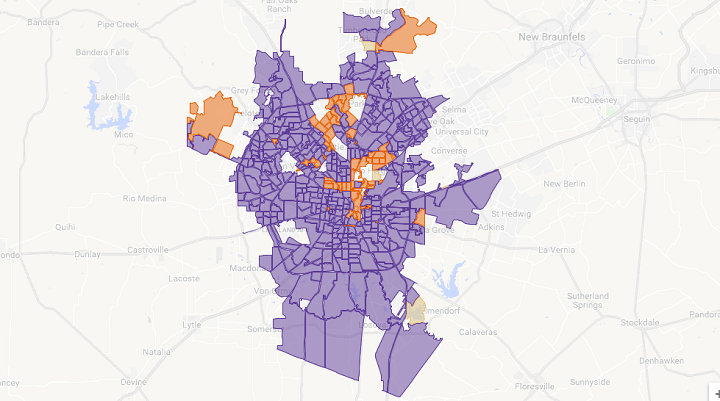
We ended up selecting the five Texas counties with the largest populations, mapped the wrong-way accidents with Google Fusion Tables, and then eyeballed each location to make sure it actually occurred on a major highway. Here’s how the finished product looked for Bexar County:

It took hours of work but the result was a set of specific crashes we were looking for. And the final numbers were surprising — Bexar County ranked high in wrong-way accidents for the years 2007-2011. It even had more crashes than Dallas County, which is more densely populated and has more traffic. To our knowledge, no one has done this kind of comparison in recent years.

If you work for a news organization and you’re jumping into data journalism (and you should be), it’s a good idea to share your methodology and findings with the government employees who oversee the data. You don’t want to be surprised by an error they catch after the story is published. And it gives the agency a chance to respond if your findings cast the agency in a harsh light.

It was certainly surprising to learn Bexar County ranked so high. The other surprise was how long the deadly problem flew under the radar. Despite several high-profile, deadly wrong-way crashes, local officials didn’t start talking about ways to prevent them until the summer of 2010.

To learn more, check out our two-part series about wrong-way crashes. And check back here when we see how the pilot program is working to stop wrong-way drivers.

Nickel and dimed: Find out which gas stations have faulty pumps that overcharge motorists

Sunday, June 3rd, 2012

Valero Station in San Antonio

If you’ve ever suspected your neighborhood gas station is stiffing you at the pump, you might already know you can file a complaint with the Weights and Measures Program at the Texas Department of Agriculture. The agency’s inspectors verify the accuracy of gas pumps.

But which stations rack up the most complaints, flunk the most inspections and cost consumers the most money?

The answers to those questions lurk within inspection data collected by state employees. The information is public. But like many government agencies, Weights and Measures hasn’t been analyzing its own data to look for trends that could help consumers make informed decisions.

So Express-News Data Editor Joe Yerardi downloaded a publicly available copy of the inspection data and took a look at it for himself.

The result was an interesting Sunday story that told readers things that state officials probably should have known themselves.

Joe learned that one out of five stations in San Antonio had at least one pump that failed inspections. The pumps that are more likely to shortchange customers are owned by one of the biggest players in town: Valero Energy Corp.

Joe mapped the locations of the stations and their inspection results, so anyone can check out the track record of their neighborhood gas station.

Joe told me it took nearly four weeks to work on the story. One of the difficulties he faced was sharing what he learned with state officials, who hadn’t analyzed their own database of inspection reports.

“It’s not their job,” Joe said, describing the bureaucratic mentality of some government workers. “It’s not what they’re paid to do.”

Not every government agency is like that, but it’s not an uncommon problem. When I found a San Antonio police database that documented every vehicle pursuit involving officers, I was a bit surprised to learn that SAPD had never analyzed the information, even though it shed light on an important public policy issue.

These agencies probably paid some poor data-entry monkey to go through each paper report and type the details into a spreadsheet or database. Why not go the extra step and analyze that information?

Joe described these kinds of stories as “low-hanging fruit” for journalists, who can step in and analyze databases that agencies aren’t scrutinizing.

“If they would go above and beyond their actual jobs, there’d be less of a need for reporters,” he said.

(Photo credit: Derrich on Flickr)

Print ain’t dead: How an itty bitty news brief sparked dozens of phone calls from readers

Monday, May 28th, 2012
The historic Wesley Peacock House near Woodlawn Lake in San Antonio, Texas

The historic Wesley Peacock House near Woodlawn Lake

With all the talk about print being dead, you’d think no one actually picks up newspapers anymore to read the archaic things.

Tell that to Elaine Austin Palmer.

Palmer curates the Wesley Peacock House, a historic home built in 1890 near Woodlawn Lake that served as the headquarters of a military academy.

I wrote a brief about the house for the Express-News’ weekly Cityscapes feature. It ran with a photo of the house on the bottom corner of page 2B of the Metro Section — about as hard to find as you can get.

Yet after the little feature was published, the calls started pouring in at the Peacock House.

Palmer emailed me a few days ago and wrote:

For our corner of the paper in the Metro Section, the Peacock House has received over 50 calls, and some still coming in — with the comments ‘How nice to know it’s still in use, I attended the academy, or I remember coming to the House way back when for a tea, etc.!

It’s good to remember the decline of print is primarily an advertising problem, not a readership problem. People still read the newspaper — even itty bitty news briefs.

Shoddy repairs blamed for elevator death at Crockett Hotel in San Antonio

Thursday, May 10th, 2012

Crockett Hotel in San Antonio Texas

How did a housekeeper at the Crockett Hotel fall six stories to her death down an elevator shaft?

A scathing report by a state inspector offers a theory.

Sometimes Plan B is better than Plan A

Tuesday, May 1st, 2012

I shot some video over the weekend but it was so windy most of the audio was obliterated. So I ended up making a music video.

It wasn’t exactly what I planned. But maybe it was better.

How Mexican cartels launder drug money in San Antonio (Hint: Check the North Side)

Thursday, April 19th, 2012


View Larger Map

Maggie’s was the place to go in the 1990s if it was late and you were a hungry college student (like me). Nestled among the car dealerships on San Pedro Avenue outside Loop 410, the two-story restaurant was open late and offered some of the best shakes ever.

Maggie’s permanently closed, reopened as a Champ’s restaurant, closed, then reopened in 2009 as Barbaresco Tuscan Grill and Enoteca, a swanky Italian restaurant.

Barbaresco was a lot different from Maggie’s. On its opening day, guests were treated to readings of Romeo and Juliet while an attractive, semi-nude woman lay on a table, her body strategically covered with pasta.

Brothers Mauricio and Alejandro Sánchez Garza had bought the old Maggie’s restaurant, along with numerous other businesses and properties in San Antonio, and heavily invested in it. Now the Drug Enforcement Administration has accused the brothers of using those businesses to launder millions of dollars in drug money from Mexican cartels.

Express-News reporters Jason Buch and Guillermo Contreras wrote about the money-laundering case in a story published Sunday. The article detailed key properties and businesses the brothers were involved in, which is a hell of a way of grabbing readers’ attention. A lot of people like me remember Maggie’s. Finding out the building is tied up in a federal money laundering investigation definitely piqued our interest.

“It allowed us to see, literally see, how everything was connected.”

I sit next to Jason in the newsroom so I talked to him a bit while he worked on the story. One difficulty he faced was keeping track of the tangled spider web of people, businesses and properties connected to the Mexican brothers. To make sense of everything, Jason used a plugin for Microsoft Excel called NodeXL, which allows you to create a social network diagram.

Jason typed in more than 250 entities and their related entities in a spreadsheet, and NodeXL displayed that information in a graph that showed spokes between each connection. Here’s an example of the main players and entities:

Money laundering social network analysis

“It allowed us to see, literally see, how everything was connected,” Jason told me.

In complicated stories with lots of moving pieces, building a chronology to keep track of key events is also important. By chance I learned about a new open source, interactive timeline tool by Zach Wise and told Jason about it. Timeline is also based on information contained in a spreadsheet. In Google Docs, you type in the dates and chatter, provide links to photos, videos, or other media, and then Wise’s Timeline tool uses javascript to display an interactive chronology that you can publish on a website.

Jason and Guillermo were going to have to write a chronology in their notes anyway. Wise’s Timeline tool let them share their relevant information with readers in a really compelling way. Their timeline looks drop-dead gorgeous. And they linked to federal documents in the timeline, so readers could see the allegations for themselves.

Maggie’s is long gone. But it was fascinating to see what became of it.

Check out every insurance claim filed against the city of San Antonio

Wednesday, April 11th, 2012

What happens when you’re hit by a city vehicle and file an insurance claim against San Antonio? Now you can find out by searching a database that tracks every claim filed against the city in the past decade.

I stumbled across this story by using Google’s advanced search options. Google lets you search specific websites for specific files and specific terms. So a way to find little-known databases and interesting stories is to search a government website for spreadsheets, pdf’s, and other type of documents.

For example, let’s say you want to focus on the city of San Antonio. In Google’s search box, you’d type site:sanantonio.gov, to limit the results to pages from the city’s website. Then use “filetype” to focus on specific types of files. The term filetype:xls searches for spreadsheets. Filetype:doc searches for Microsoft Word documents. Filetype:pdf searches for … you guessed it, pdf files.

You can do broad searches or get creative and add words you think might lead to interesting stuff. Check out this search with the term “injuries.”

Advanced Google search results for the city of San Antonio

One of the top results is a form for a vehicle accident report that is filled out by city employees whenever they’re involved in an accident. All the entries and check boxes in the form suggest this information is typed into a database of some kind. And if that’s the case, that means you can request the data, analyze it yourself, and see if there’s a story lurking in those numbers.

Using the Texas Public Information Act, I asked for any database the city had that tracked insurance claims from vehicle accidents. The process took awhile and there was a lot of back and forth. At first, the city’s Risk Management Office only sent me a pdf with two categories of information: case numbers and dates. The format and info was worthless.

But eventually they sent more complete spreadsheets that tracked the dollar amount of the claim, whether it was denied, and a brief description about what happened. It was interesting reading.

No one outside City Hall had ever looked at this data before. Thanks to a nifty Google search, now everybody can.

Daily Diversion: Tedesco munchkins invade Woodlawn Lake Park

Monday, March 26th, 2012

Our wacky kids acting like themselves in public. No ducks were harmed in the making of this video.